Kyle Kirkwood Wins Freedom 250 Grand Prix on Streets of Washington
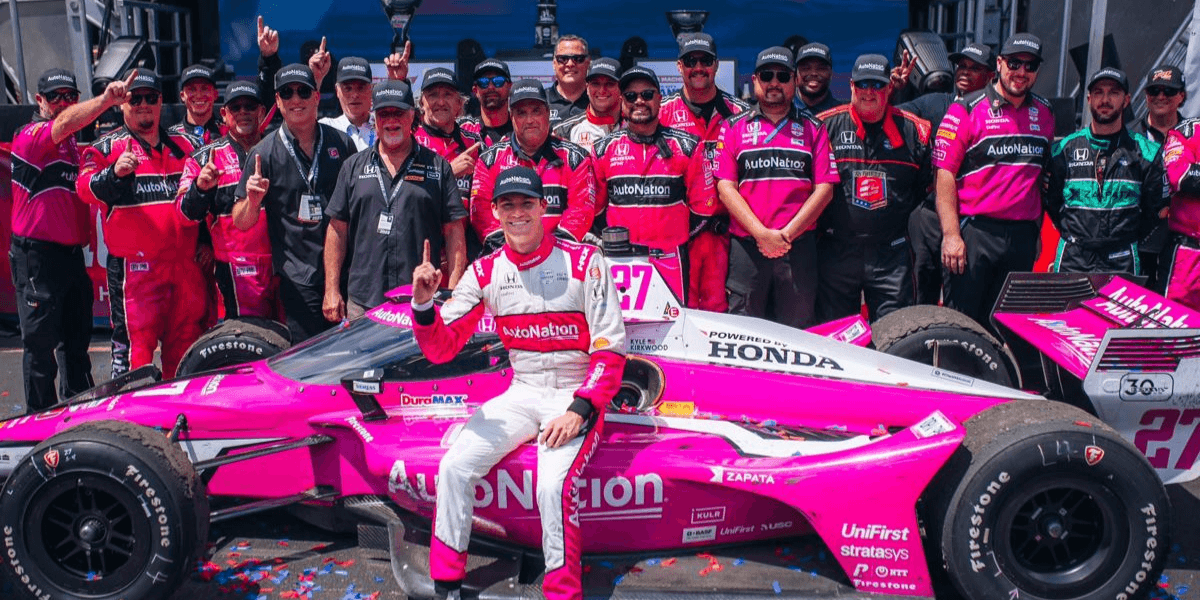
Kyle Kirkwood won the Freedom 250 Grand Prix in Washington, D.C., on Monday after IndyCar drivers competed on a temporary street circuit around the nation's capital.
The race brought high-speed open-wheel competition directly into downtown Washington, with drivers reaching speeds of approximately 160 mph on sections of the course. The event attracted an estimated 150,000 spectators, according to reporting on the race.
The unusual setting made the event one of the more distinctive races on the American motorsports calendar.
Instead of competing on a permanent road course or oval, drivers navigated a temporary circuit laid out along major streets near the National Mall.
Street races create different challenges from permanent circuits. Drivers have less room for error because concrete barriers and walls are positioned close to the racing surface.
The narrow environment can also make passing more difficult, increasing the importance of qualifying position, pit strategy and precise driving.
Kirkwood's victory came in front of a large crowd gathered in the center of the capital.
The event transformed normally busy city streets into a professional racing circuit, requiring extensive preparation and temporary changes to transportation patterns.
For spectators, the setting offered an unusual opportunity to watch a major motorsports event against the backdrop of some of the country's most recognizable landmarks.
The race also demonstrated the continuing expansion of motorsports beyond traditional racing venues.
Street races have become an important part of major racing series because they allow competitions to reach large urban audiences. They can also create a different atmosphere from events held at permanent tracks located outside major population centers.
Washington provided an especially distinctive backdrop.
The circuit passed through areas surrounding the National Mall and other prominent parts of the capital, placing the race in the middle of one of the country's most recognizable urban environments.
The estimated 150,000 spectators underscored the event's ability to attract an audience beyond traditional motorsports fans.
The competition also required drivers to adapt quickly to an unfamiliar environment.
Street circuits often contain sharp corners, short braking zones and uneven surfaces. Unlike permanent tracks, they may include road markings, manhole covers and other features that drivers do not encounter on purpose-built racing facilities.
Those characteristics can affect vehicle setup and driving style.
High speeds add another dimension.
When cars approach 160 mph on a temporary circuit surrounded by barriers, precision becomes essential. A small mistake can produce a major incident.
Drivers therefore have to balance aggression with caution throughout the race.
The event also required significant logistical planning. Closing major city streets for a professional race involves coordination involving transportation authorities, public safety agencies, event organizers and local businesses.
The economic impact can extend beyond ticket sales because large events bring visitors who spend money on hotels, restaurants and other services.
For Washington, hosting the race also provided a major public event during the summer.
The combination of sport and urban entertainment can attract people who might not otherwise attend a motorsports event.
The race therefore served as both a sporting competition and a large-scale public spectacle.
Kirkwood's victory gave the event its sporting centerpiece.
Winning on a temporary street circuit requires consistency because opportunities for recovery can be limited. Drivers must manage tire performance, traffic and pit strategy while avoiding contact with barriers.
The race's result consequently reflected both speed and precision.
The Washington event also demonstrated how motorsports can adapt to new locations.
Permanent racing facilities remain essential to the sport, but temporary circuits allow racing organizations to bring competition directly into major cities.
That model can increase visibility while providing spectators with a more accessible experience.
For drivers, however, the challenge is substantially different.
A city street does not offer the same forgiving runoff areas found at many permanent circuits. Barriers are often close to the racing line, meaning mistakes can immediately end a driver's race.
That creates an additional layer of pressure.
The Freedom 250 Grand Prix therefore offered both drivers and spectators a unique experience.
The event combined elite IndyCar competition with the scenery and infrastructure of the nation's capital, turning Washington streets into a temporary professional racing venue.
Kirkwood emerged as the winner, but the broader significance of the race was its unusual setting and the scale of the audience it attracted.
The event showed how major sporting competitions can temporarily transform familiar urban spaces into venues for high-speed competition.
For motorsports fans, the Washington race provided a different kind of challenge from conventional tracks.
For the city, it created a large public spectacle centered on one of America's most technologically demanding forms of racing.
The Freedom 250 ultimately placed IndyCar at the center of Washington's streets and gave Kirkwood a victory in one of the most distinctive racing events of the season.

Men's Newspaper Contributor
This article features partner, contributor, or branded content from a third party. Members of the Men's Newspaper editorial staff were not involved in the creation of this content. All views and opinions are those of the contributor alone.
You May Also Like